
Honda CR-V: Jump Starting / What to Do After the Engine Starts
Once your vehicle's engine has started, remove the jumper cables in the following order:
- Disconnect the jumper cable from your vehicle's ground.
- Disconnect the other end of the jumper cable from the booster battery
 terminal.
 - Disconnect the jumper cable from your vehicle's battery
 terminal.
 - Disconnect the other end of the jumper cable from the booster battery
 terminal.
Have your vehicle inspected by a nearby service station or a dealer.
The indicators for the Adaptive Cruise Control (ACC)
with Low Speed Follow, Road Departure Mitigation
(RDM), Vehicle Stability Assist™ (VSA®) system,
Vehicle Stability Assist™ (VSA®) OFF, Collision
Mitigation Braking System™ (CMBS™ ), low tire
pressure/TPMS, and Parking Brake and Brake System
(Amber) may come on along with a message in the
Driver Information Interface when you turn the
ignition switch to ON  *1 after
reconnecting the
battery.
*1 after
reconnecting the
battery.
Drive a short distance at more than 12 mph (20 km/ h). The indicator should go off. If it does not, have your vehicle checked by a dealer.
*1: Models with the smart entry system have an ENGINE START/STOP button instead of an ignition switch.
 Jump Starting Procedure
Turn off the power to electric devices, such as the audio and lights. Turn
off the
engine, then open the hood.
Open the terminal cover on your vehicle’s
battery positive terminal...
 Shift Lever Does Not Move
Follow the procedure below if you cannot move the shift lever out of the
position.
Releasing the Lock
Set the parking brake.
Models without smart entry systemRemove the key from the
ignition switch...
Other information:
Honda CR-V 2017-2026 Owner's Manual: With Little Chance of a Collision
The CMBS™ may activate even when you are aware of a vehicle ahead of you, or when there is no vehicle ahead. Some examples of this are: When Passing Your vehicle approaches another vehicle ahead of you and you change lanes to pass. At an intersection Your vehicle approaches or passes another vehicle that is making a left or right turn...
Honda CR-V 2017-2026 Owner's Manual: Siri® Eyes Free
You can talk to Siri using the (Talk) button on the steering wheel when your iPhone is paired to the Bluetooth® HandsFreeLink® (HFL) system. Siri is a trademark of Apple Inc. Check Apple Inc. website for features available for Siri. We recommend against using Siri other than in Siri® Eyes Free while operating a vehicle...
Categories
- Manuals Home
- Honda CR-V Owners Manual
- Honda CR-V Service Manual
- Oil Check
- Interior Fuse Box
- Odometer and Trip Meter
- New on site
- Most important about car
How the Front Airbags Work
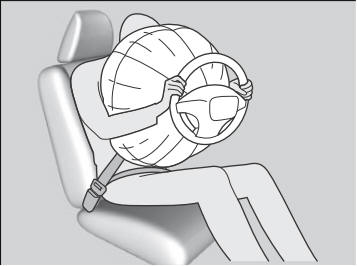
While your seat belt restrains your torso, the front airbag provides supplemental protection for your head and chest.
The front airbags deflate immediately so that they won't interfere with the driver's visibility or the ability to steer or operate other controls.
